Although I appreciate the kind words and those who wish to follow this site , please know it is now a closed site. Thank you .
Although I appreciate the kind words and those who wish to follow this site , please know it is now a closed site. Thank you .

Although flattered that I still receive followers to this defunct site, I feel obligated to stress that I no longer post on Babylon Baroque. Although I personally use this site as an archive for information that is of interest to me, I have since moved on to studio work. Updates from the studio can be found at http://www.boondocksbabylon.com.
I would be delighted if you followed me there.
Be well, Leonard
In the aftermath of the recent bombing at the Boston Marathon, “why?” is the constant refrain from my mother-in-law smugly snug in her Fox network cocoon.
Why, as if we, the “blessed”, are somehow miraculously immune from the horrors the world bears witness to day in and day out.
I am just as smugly content in my own cocoon; the very day of the bombing I was reading that morning’s New York Times and blithely by-passed an article concerning a bombing in Somalia, 2o left dead. Yet this domestic act of terrorism does hit home and it does hold my (our) interest , self absorption one of our lesser sins. This self absorption was stunningly reported in today’s NYT, when interviewing a participant, the New Hampshire native reflected “It’s heartbreaking to not cross the finish line, you train so hard for this, …It’s sad, but I’m safe.” although I am happy she is indeed safe I would prefer for her to express gratitude, her concern about having not finished a race seems indelicate given the grief experienced by so many.
What has struck me as singularly painful is the amount of amputees these jerry-rigged pressure cookers created. Although not at all cavalier, three reported deaths seemed to me at the time to be less devastating- we after all, bore witness to 9/11.
But the subsequent images of amputees: the pain, the pale bloodless faces, the kindness of stalwart by-standers, these images touched me deeply. In pondering this current horror, I instictively turned to a master at depicting pain, Otto Dix.
Dix as many know, was a fervent chronicler of the unpleasant , the ugliness of man; he was also an expert at depicting the amputee, often as a criticism of war and its excesses. On an unconscious level I turned to Dix and of course found numerous images, disturbing, awful, yet human. I will not post them all, the link above provides a full catalog of his work, but this one, from 192o, The skat Players is a personal favorite.

Otto Dix
The Skat Players
1920
Oil and collage on canvas
Staatsgaleries, Stuttgart
The following link from MOMA gives an insightful analysis of the work, MOMA link .
This will pass, but in the mean time I hope to carefully and thoughtfully take every act of terror personally, or to at least read the full article. It is the least I can do.
Until next time, take care,
Babylon Baroque
The notion of Hell Mouth has been on my mind, Holy Week has just passed, Christ’s descent into Limbo, often referred to as the Harrowing of Hell being first and foremost. I also happen to be working on a series of painting in which the Gates of Hell feature more or less rather prominently. To see examples of the progress check out my studio journal Boondocks Babylon, link in sidebar.

My most direct inspiration for Hell Mouth being Andrea Mantegna’s depiction of Christ’s descent into darkness.
 Andrea Mantegna
Christ’s Descent into Limbo
1468
Frick
Another inspiration, one I have turned to time and again is the monstrous gates at the Parco die Mostri.
Incredible beyond belief.

In my research, collecting various reference materials I soon came to realize Western Christians weren’t the only ones depicting the entrance to the Underworld with such ghoulish excess. Examples could be found in Asia, most specifically outside of Laos at Xieng Khuan, often referred to as Buddha Park. although not ancient, I believe built mid-century, they draw upon an outlandish tradition, clearly delighting in the creation of such demonic follies.

One may also turn to Mesoamerica at the Maya site of Chicanna. At the site “monster mouths” had provided a dramatic backdrop for ceremonial processions, now marvelous photo opportunities.
For those not familiar with Mayan architecture the details can be puzzling given the geometric stylization, I suggest enlarging the image (all of the images for that matter). The eyes and teeth will become visible as you examine the complex design ;the visual puzzle it part of the pleasure I find in Mesoamerican art.

But I must confess the Hell Mouth that touches my heart the most is the architectural pastiche found in Montmartre at the sublimely bizarre cabaret l’Enfer. The entrance captured below by Atget.
 facade of l’Enfer
photograph by Atget
The excessive sense of fun is such a pleasure , Philippe Jullian in his indispensable Montmartre tells us that the facade is essentially cardboard and plaster- but what wondrous paste.

The above image is terribly small, but if you are interested more images can be found at this link.
I’m particularly delighted by this interior image, I snagged it from the wonderful blog Haunted Lamp (see sidebar) quite some time ago and I have treasured it ever since.

In case you haven’t had your fill of fin de siècle smoke and mirrors check out this video clip bursting with vintage posters and publicity shots. I’m tickled by it .
As is so often the case this blog acts as a great organizing tool for my ideas and interests; I am so pleased that so many readers have shared these interests.
Until next time,
take care,
Babylon Baroque
As the feast day of St. Patrick is fast approaching , I thought it a good idea to remember that Ireland has not one but three patrons. The familiar Patrick, St. Columba (perhaps another post) and dear Brigit-Brigid-Bridget (feast day Feb.1).
 print of the saint by Currier & Ives
I start with this very sentimental image as it is in my own collection of saints. I have owned it for years but for some reason I have never before realized/remembered she was the patroness of Ireland. Reading the NYT the other day, an article concerning an outburst of thefts, holy relics being the target , I was relieved to hear that the “Mary of the Gael’s” jawbone was indeed safe and sound ,only the reliquary was stolen.
Good news I suppose.
Looking up from the paper I began to view my now familiar Bridget with new sense of appreciation.

Brigit of Kildare (451-525) is best known as the foundress of a school of art known for its metalwork and illumination. The school is most remembered for the Book of Kildare, now lost to time. We do of course have the familiar Book of Kells, so I will include an illumination of the Madonna and Child essentially because it is lovely.
For more info concerning Brigit, check out this link.

click to enlarge
With that, have a very happy Saint Patricks Day!
Until next time,
take care,
Babylon Baroque

You may have seen this video clip, but I hadn’t until this evening when my dear friend Eleanor emailed a link , quite large and glorious link I might add.
Alas I am having trouble accessing the larger format, but the enclosed link is still pretty spectacular.
Aside from the sheer breathtaking beauty of hummingbirds and iridescent bees, the bats are what blew me away. A long time lover of the little winged buggers, the close-ups in this clip are stunning. The mama bat with her kitten (?) is frankly too much. Delightful beyond measure.
I hope you enjoy it as much as I did.
Thanks E!
I have for some time felt a terrible ennui concerning posts, truly struggling to find points of interest and the words to express them.
The truth is I am entering a period of reflection, I find myself more and more interested in MAKING, instead of discussing (at times pontificating) about what has been made. My blogging friends , Thom of the marvelous Form is Void and the very fine artist Clive Hicks-Jenkins have offered splendid support in this arid period. As have other readers, I appreciate that.
Clive in particular has offered wise advice, if you are not interested in yakking away ,why not post the progress of your work?
I had thought of that before, and I have from time to time posted snippets of my work. But I confess a hesitancy. When I have posted work the response has from time to time been quite vitriolic, I was shocked by the harshness. I am self taught/self learning, it is often a rough road for me. I struggle with how things “ought” to look, my desire to emulate work that I so enthusiastically admire and a constant fear that the sand is slipping away so very quickly.
At times it is crippling, the harsh critique, even when warranted- which most likely it was- only added to the chorus within my head. For that reason, I have hesitated to take Clive’s advice and emulate his own delightful Artlog.
But I have now decided my timidity is hampering any opportunity to record my progress, to explore other options and to openly engage with others. For many (most) of my readers the new blog Boondocks Babylon will be of little interest. It will be a space devoted to personal reflection, my struggles in the studio and day to day concerns. I really ought to make it a private blog, but I have developed friendships through Babylon Baroque and wish to extend an invitation to those readers to pop in from time to time.
Babylon Baroque will continue, the posts may be less frequent, but my interests in art and culture will surely be piqued once again ; I will reserve this blog for established art.
For now, Boondocks Babylon will keep track of my own daubs.
Until next time,
please take care,
Babylon Baroque
Garnier Opera House, Paris
 We recently had the good fortune of catching the final performance of the San Diego Opera’s production of Salome. As I really am only familiar with our dear minx by way of Oscar and Aubrey I wasn’t sure what to expect.

I was delighted, most particularly with the lead soprano Lise Lindstrom, she gave a marvelous performance. As is so often the case I was drawn to the sets and costumes, in particular her gown in the final scene. It was, I declared with great bombast the perfect yallerish, Oscar would have adored the color. Unfortunately yallerish is incorrect, a quick Google search for the word provided only my own blog as the source, I have made MANY references to the word, all of them incorrect. I feel a bit of a fool.
The correct word to describe this Aesthetic Movement staple is Greenery-Yallery. First termed it appears by the witty duo Gilbert and Sullivan for their production of Patience in which they mercilessly lampoon lily- wristed blue-and-white china lovin’ aesthetes with utter abandon.
“A pallid and thin young man
A haggard and lank young man
A Greenery-yallery Grosvener Gallery
Foot-in-the -grave young man!”
This 1882 greeting card illustrates the sort of fellow perfectly.

Wilde did of course make ample use of the color yellow, there is his poem Symphony in Yellow.
The drawing room at Tite Street was described as having dazzled in “greenery-yallery” effect 1909 source
And of course there was that notorious yellow book found on Wilde’s person at the time of his arrest; alas it was not THE Yellow Book so loved by the “foot-in-the-grave” set.

Yellow Book, volume 3, October 1894
My only real disappointment in the San Diego production was the executioner of Blessed Jachanaan. In my fantasy he would appear as that bit of stellar beef ( Duncan Meadows) from the Royal Opera House production .
Unfortunately he was a rather chunky fellow with bad posture, quite a let-down.

Duncan Meadows, Royal Opera House production of "Salome"
For a snippet of the final scene with the minor deity( and his mighty sword) check out this clip
The Duncan Meadows “lead” so to speak was from my friend the artist Clive Hicks-Jenkins.Clive not only is a most impressive artist,but a blogging wiz, he kindly walked me through the compexities of WordPress.
Although I have been blogging for quite some time, I must have become rusty ( or WordPress has become more persnickety).
I thank you friend, a fresh day and a constant visit to “save draft” seems to be the trick.
Knowing that once again I may post freely is a tremendous relief. I am now posting far less frequently than I have in the past. I hope my readers understand that my life is now often spent in my Hermitage ( my pretentious little studio); posting is becoming less and less a priority, but when the spirit and time allows I will indeed be back.
I am touched at the swelling number of followers, perhaps I ought to give it all up for good if the number of “hits” is any indication of activity when I am so very fallow.
Wishing all a “utterly charming” day!
Take care,
Babylon Baroque
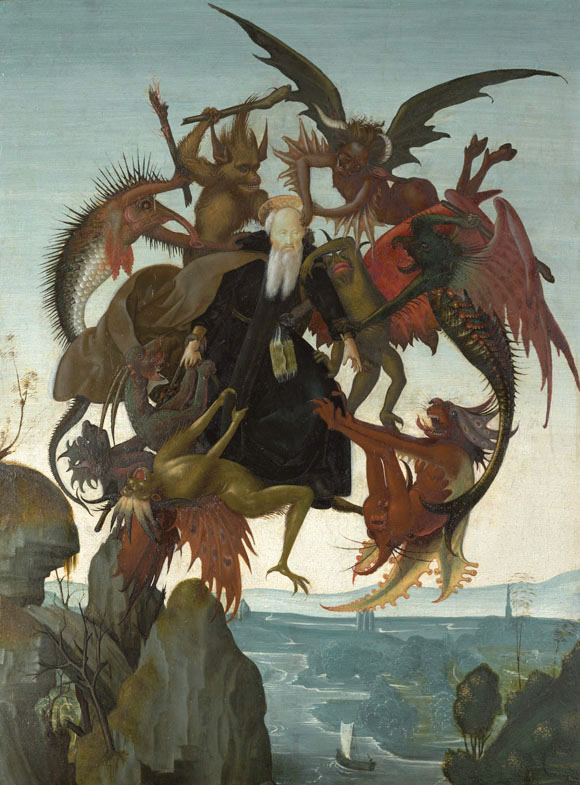
As today is the feast day of St. Anthony the Abbot, I thought it best to honor him with this image of the poor fellow bedeviled by temptation.
The painting, now at the Kimball Art Museum is by the ridiculously young Michelangelo, 12 or 13, frankly all terribly depressing ; for more details read this 2009 New York Times article.
 Michelangelo Buonarroti
(1475-1564)
The Torment of St. Anthony
Kimbell Art Museum, Fort Worth, Texas
Once again faithful Vasari provides clues to this wonder, to Vasari’s glee the young fellow made a “perfect pen-and-ink copy” of the Martin Schongauer original. Working from a copper engraver the ambitious boy had purchased on his own, he dazzled his contemporaries and secured “considerable fame”. Not content to sit on his laurels (something I would be all too willing to do), the young Buonarroti quickly began a colored copy, according to Vasari:
“…in order to copy some of the strange looking demons in the picture he went along to the market and bought some fishes with fantastic scales like theirs.”

Detail of “fantastic scales”
source, NYT, click for more details
Given the blessed abbots desire for solitude, I think he makes a wonderful patron for artists; I am deeply drawn to images of the saint happily ensconced in his charming hermitage, a decorative skull comfortably placed on his rustic worktable. Perfection.
This weekends paper had an article concerning solitude and creativity, it only confirmed my own beliefs; if you wish, check it out with this link.
Those familiar with my blog know my penchant for George Méliès, I wasn’t going to replay this St. Anthony clip, but since I saw Hugo this weekend I really could not resist. It is incredibly delightful and funny.
For those inclined to something less irreverent, here are two prayerful clips, less fun but…
and
I will now close, must dash off to the gym, then lock myself in my hermitage; I happen to have a skull- fuschia, with glitter.
Anthony would have approved.
Happy Feast Day Saint Anthony!
Take care,
Babylon Baroque
As it has been quite some time since my last post, I have felt increasingly anxious about updating. Given the length of time in which I last checked in I really wanted this post to be rather special.
Alas it isn’t going to be. My new life, here in San Diego is frankly banal, frightfully banal. I am here, ostensibly to tend to the mother-in-law; I spent most of today cooling my heels while she had her hair done.
I need to work on this.
Until that time, I will continue to lock myself in my studio, and in between my monastic retreats continue to patronize the numerous used bookshops in Hillcrest. They offer great solace, particularly as I am essentially living in a cultural wasteland.
Once again lovely musty books come to my rescue.
What popped out on a recent afternoon visit were several volumes on Piero della Francesca, a great favorite and one volume on Jared French. I’ve been thinking about French ever since George Tooker died. When I had written that post I felt a strong connection between Tooker ( and French) and Piero della Francesca. I quickly found out this was common knowledge, but I still find it very exciting. As I personally struggle with incorporating humanist elements into my own work, to see how seamlessly French accomplished this is encouraging, daunting and thrilling. One painting (of many exciting paintings) really stands out, that is Washing the White Blood from Daniel Boone; it is such a rich image, its Renaissance roots are palpable.
 Jared French
Washing the White Blood from Daniel Boone
egg tempera on gesso panel
William Kelly Simpson
The book I happen to be reading concerning French and his work is Nancy Grimes’ Jared French’s Myths, it really is marvelous, you might want to add it to your own collection. She points out the della Francesca inspiration, particularly concerning this painting; she very reasonably presents the Baptism of Christ.
 Pierro della Francesca
Baptism of Christ
1448-50
egg tempera on poplar board
That connection is quite right, but so many of della Francesca’s painting must have influenced French ( and Tooker and Cadmus). My own random browsing of della Francesca’s work led me to his still arresting image of Hercules.
 Hercules
1465
Fresco
Isabella Stewart Gardner Museum, Boston
Stumbling about, I came upon this sketch by French for Washing the White Blood from Daniel Boone; I’m always bewildered and intimidated by the “sketches” of the great.
What is so very frustrating about French isn’t his enigmatic images, what is so challenging is how little seems to be known about the fellow. Grimes does an admirable job piecing together bits of the puzzle; but from my research I could find very little new information. Even Wikipedia was mute.
I rather prefer the mystery that surrounds this boy from New Jersey ( my own home state), I will continue to grapple about for new tid-bits, enjoying his incredible work as I go about the task.
 Jared French, January 25th 1939,
taken by Carl Van Vechten
This video clip has many more images of French’s work, worth checking out if so inclined.
Once again, please pardon this rather pedestrian post. The dust from packing has just settled, my studio is now freshly set up, still much to do of course, but beginning to feel a bit like home; albeit one situated in a rabidly right wing environment with a rather daunting homophobic mother-in-law.
Wish me luck.
Until next time,
Babylon Baroque


 Babylon Baroque
